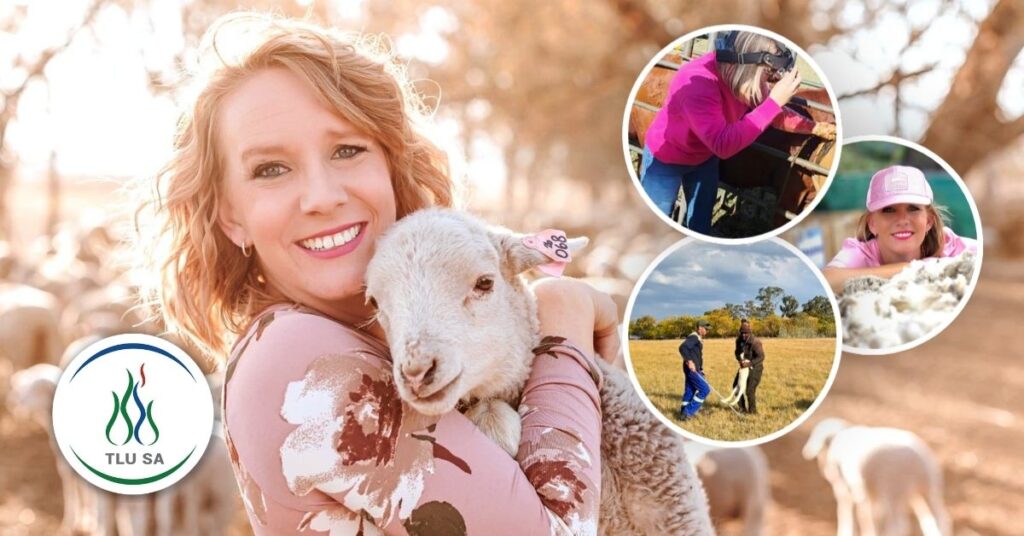
Every camp, every improvement and every animal at Solms Farming tells a story of hard work, sacrifice and the determination to build something meaningful from very little.
Marissa Solms, from Utrecht in KwaZulu-Natal, did not inherit an established family farm. She and her family have built their farming enterprise themselves over the past decade or so. Today, she is one of the top three finalists in TLU SA’s Young Farmer of the Year competition. The winner will be announced on 2 September during TLU SA’s Congress Dinner.
Solms Farming focuses primarily on Merino sheep, with particular attention given to flock management, reproduction, lamb survival and improving wool and meat quality. The farm also has a cattle enterprise and continues to expand in a systematic and sustainable manner.
Solms is actively involved in virtually every part of the operation, from caring for and feeding the animals to administration, record-keeping, planning and the day-to-day management of the farm.
“I am a woman, mother, wife and farmer. To me, farming is not merely an occupation, but a way of life,” she says.
Not inherited, but built from the ground up
Solms’s journey in agriculture began with a love of animals and farm life, as well as a desire to build something of their own. They started small and expanded and improved the farming operation year after year.
According to her, however, their greatest progress cannot simply be measured by the increase in the number of animals. It lies rather in the fact that they have learnt to farm more effectively with the resources available to them.
“Our goal is not to have the biggest farming operation. We would rather have a healthy, productive and sustainable flock in which quality is more important than quantity.”
Over time, the farm’s focus shifted towards improved reproduction, targeted nutrition, higher lamb survival rates, strict selection and better wool quality. Each animal is assessed individually to understand why certain practices work and where adjustments are needed.
Solms says she is particularly proud of the development of their sheep flock and the improvements they are able to observe from one year to the next.
“We did not start with an established family farm. Every camp, every improvement, every animal and every step forward represents hard work and considerable sacrifice.”
Better management through better information
Building a farming operation with their own resources, amid rising input costs and unpredictable income, remains one of their greatest challenges.
Drought, feed prices, animal health, climatic conditions and market prices are not always within a farmer’s control. Solms therefore tries not to wait until problems arise before responding, but instead plans ahead through budgeting, nutrition, preventative measures and meticulous record-keeping.
“I have learnt that things will go wrong in farming. You have to learn from them, adapt and try again.”
For Solms, technology does not have to be complicated or expensive to add value. The farm uses records and data to monitor the reproduction, nutrition and performance of individual animals.
Feeding programmes are planned according to the different production stages of ewes and lambs, while grazing utilisation, flock health, lamb survival and selection are continuously evaluated.
Her approach is simple: “If we can measure something, we can manage it better.”
A family effort
Although Solms is actively involved in both the practical work and management of the farm, she emphasises that a successful farming operation is never the work of only one person.
Her husband is responsible for, among other things, the financial and accounting aspects of the operation, while their respective skills complement each other in managing the farm. Their foreman and three employees play an important role in carrying out the practical work every day.
Her children are also part of farm life and, from an early age, are exposed to the origins of food, the value of responsibility and the importance of patience.
“It is very special to me that they can grow up seeing that food does not simply come from a shop and that success requires hard work, responsibility and patience.”
A farmer first, but also an example to women
Being named one of the three finalists holds particular significance for Solms as a woman, although she regards herself first and foremost simply as a farmer.
She has encountered situations in which people assumed that her husband was the farmer or that she was not the person making important farming decisions. Instead of trying to prove her abilities through words, she allows her knowledge, work and results to speak on her behalf.
“When you know your animals, understand your figures and are willing to do the work yourself, people’s perceptions change naturally. I do not want to farm better than a man because I am a woman. I simply want to be a good farmer.”
According to Solms, many women bring valuable strengths to the agricultural sector, including attention to detail, observation, care and organisation. These skills are particularly important in livestock farming, where small changes in an animal’s behaviour may provide an early indication of a larger problem.
Women, however, often have to fulfil several roles simultaneously. They are farmers and decision-makers, but also mothers and wives, and are frequently responsible for a significant share of the household and administrative work.
“Women do not have to try to be men to succeed in agriculture. We should use our own strengths and be comfortable with the fact that we sometimes approach things differently.”
Recognition for every sacrifice
Solms entered the competition to assess herself and the farming operation, acquire new knowledge and critically determine where they could improve. She also wanted to show that a person does not have to inherit a large, established farming operation to earn a place in agriculture.
According to her, being named one of the three finalists is recognition for her entire family, their employees and everyone who has worked alongside them and believed in the farm over the years.
Should she be named TLU SA’s Young Farmer of the Year on 2 September, the title would confirm that it is possible to build something meaningful from very little when a person is willing to work hard, learn and persevere.
She wants to set a simple example for her children: you do not have to start with everything to achieve something remarkable.
Solms also hopes that her place among the finalists will encourage other women to claim their place in the agricultural sector.
“If my place among the finalists makes just one young girl or woman think, ‘Perhaps I can do it too,’ it would mean a great deal to me.”
Her vision for the next decade is a better farming operation: a healthy and productive sheep flock with excellent reproduction, high lamb survival rates and good-quality wool. She also wants to continue improving the farm’s infrastructure and grazing management, while using data to make more precise decisions.
“I farm because I believe we are called to care, with love and responsibility, for what has been entrusted to us, and to leave behind something better than what we received.”